No messages yet. Start the conversation!
Quality
When it comes to wellness, every detail matters.
At RadwaMinta, there is no such thing as an “off-season” item. We know how to store every product under the best and most suitable conditions to maintain its quality. However, we always prefer to provide each product during its natural season to ensure maximum freshness and authenticity.
Our quality and safety measures strictly comply with international standards. We implement precise, up-to-date, and cutting-edge practices to guarantee the highest level of protection for our customers’ health.
Beyond that, our Quality Control Department is continuously seeking new ideas and innovative approaches to enhance and safeguard product quality. Our ultimate goal is to protect not only our customers, but also the environment, the soil, the water, and the community around us.

#1 First stage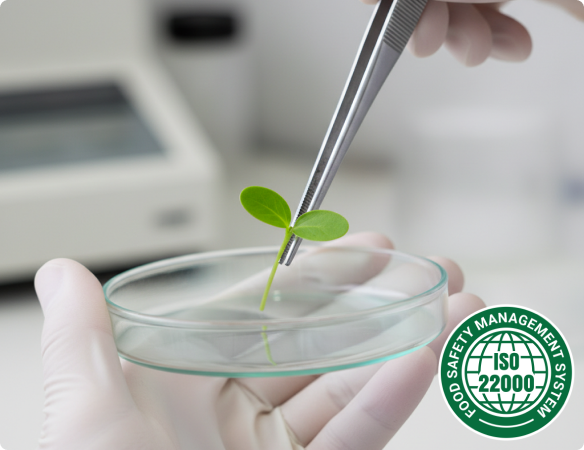
Sampling Standard Procedure
Quality Control Sample Distribution and Testing
Test1
The raw material sample
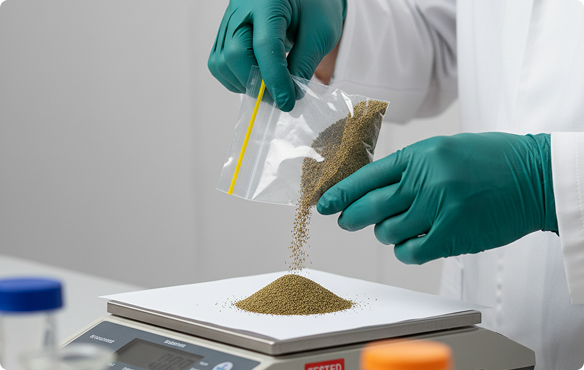
From every batch of raw materials, samples are collected from different depths of each sack and then combined into one composite. This composite is divided into ten sub-samples, each labeled with the necessary details such as farm name, crop, plot location, date, and protocol.
The sub-samples are tested for visual quality, pesticide residues, microbial and aflatoxin levels, essential oils, and moisture content. To ensure traceability, extra reference samples are securely stored for at least two years, in line with the product’s shelf life.
All results are carefully recorded and archived in the company’s quality system to guarantee safety, consistency, and transparency.
Test2
The final product sample
Final product sampling follows the same rigorous protocols established for raw materials. Each batch is carefully inspected and tested to confirm consistency, purity, and compliance with the defined standards.
In addition, an advanced metal detection analysis is performed as an extra safety measure, eliminating any possible risk of contamination. All results are recorded, documented, and archived within the company’s quality system to guarantee traceability and full accountability.
#2 Second stage
Processing Stages
The raw material passes through several steps reaching the final products.
#3 Last stage
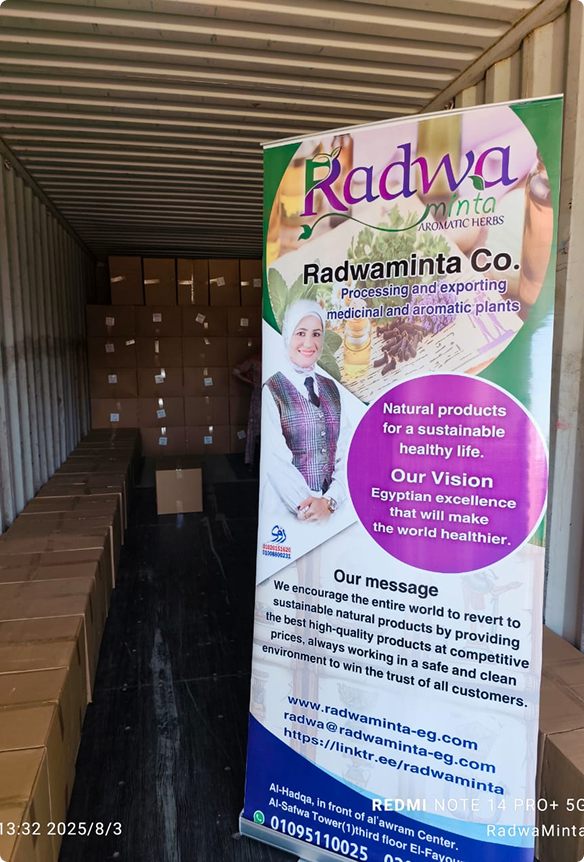
Packing and Labeling
Standardized Packaging Material Specifications and Labeling Procedures for Traceability and Compliance
For seeds and crushed leaves, the products are packed in three-layer paper bags, with the outer seal secured mechanically.
For powder and TBC, the same three-layer paper bags are used with a mechanical outer seal, in addition to an inner plastic liner sealed with a releasable cable tie to ensure maximum protection.
For flowers and whole leaves, the products are packed in carton boxes to preserve their integrity and quality.
All packages are clearly labeled with our company label and sealed according to international standards. Packing materials are completely untreated, and every product carries the statement “100% Clean.” Each label includes essential details such as weight, batch/lot number, production date, origin, and expiry date to guarantee traceability and compliance.
Standard Packaging Formats
| Type | Weight | Product specification |
|---|---|---|
| Box | 5 kg | Whole leave |
| Box | 10 | Flower |
| Bag | 25 | Petals |
| Bag | 25 | T. b .c |
| Bag | 25 | Seed |
| Bag | 12 : 20 | Crushed |
| Bag | 10 | Large cut |
| Bag | 25 | Fin cut |
| Bag | 25 | Sifting |
certificates
RadwaMint’s Certificates
1 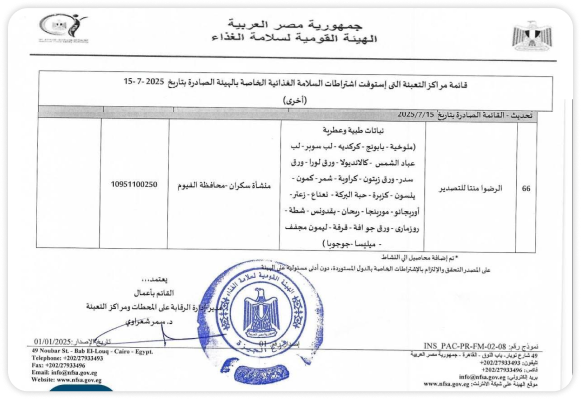
Egyptian Food Safety Authority Certification
RadwaMinta is certified as the first center for packaging medicinal and aromatic plants in Fayoum and Egypt, led by a businesswoman on the White List of the Egyptian Food Safety Authority.
2 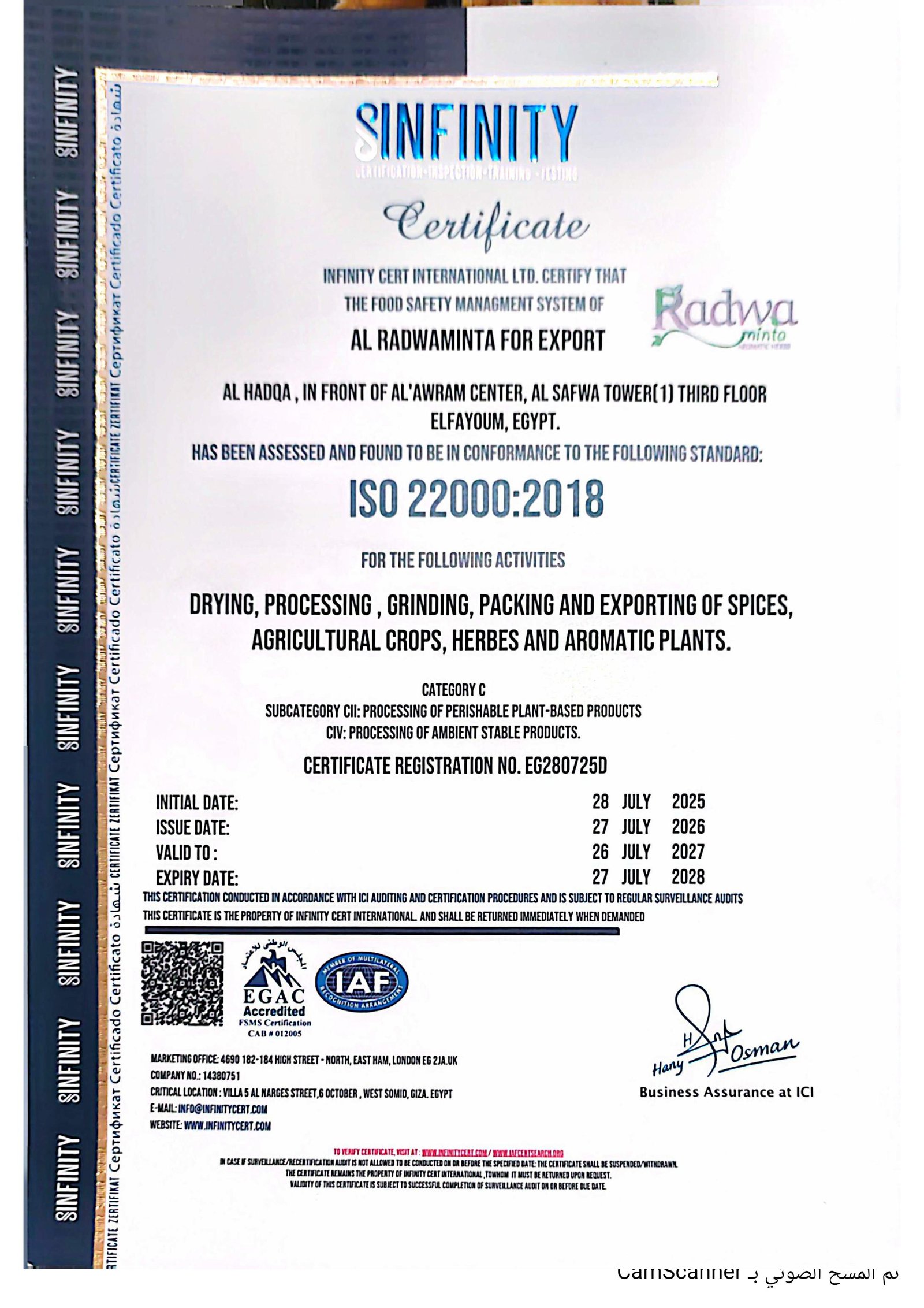
ISO 22000 Certification
RadwaMinta is ISO 22000 certified, ensuring that all processes meet international standards for food safety and quality management, from sourcing to final packaging.